Trekking Considerations:
Q: What is the most popular Trek in the Khumbu ?
A: The trek to Everest Base Camp (EBC) is by far the most popular. There are many variations to get there in addition to going straight up the valley. For example, you can go by way of Goyko for a great diversion. A side trip to Chhukhung Valley is also well worth it. Trekking in eastern Nepal in the Annunapurna area is also extremely popular. Another emerging popular trek is the Manaslu Circuit.
Q: How do you join a trek to Everest Base Camp? Can I trek with Everest climbers?
A: Almost every climbing guide company offers a trekking option to their climbing expeditions. But there are also trekking only companies that do a great job. Many companies based in Kathmandu offer treks, however be wary of the lowest cost ones. In 2014, The Nepal Government started to require all trekkers to have a guide, but it is unclear if this is enforced. A permit is required to enter the Sagarmatha National Pak where Everest is located.
Q: How long does it take to trek Everest Base Camp??
A: It depends on your route but most EBC treks take about 20 days. You do not want to go on a rush trek primarily due to the altitude. You land in Lukla at 9250' and go to EBC at 17,500. If you go too fast you will get altitude sickness which can be deadly.
Q: I read that a trek is very easy and anyone can do it. Exactly how hard is it?
A: If you can walk 5 miles a day and are in good aerobic shape (with a doctor's approval) you should do fine. The actually trekking is on mostly level ground with a few sections of steep hillsides - up and down. You should not be carrying more than a light day pack with a jacket, water and snacks. However, it is the altitude the creates the main issues. That said, the better shape you are in, the more you will enjoy the overall experience.
Q: Is a trek dangerous?
A: Yes and no. Yes; because altitude can kill people so care must be take to acclimatize properly. No; from the lack of so-called "objective" danger such as rock fall or crevasses normally associated with climbing. However, people have been seriously injured by yaks who inadvertently bump them off the trail and down a steep hillside. So always be on the uphill side when a yak passes by! There have been kidnappings, attacks and murders in this area, so be street smart.
Q: Is it better to go in spring or fall and what is the weather like each season?
A: The spring season starts cold and gets warmer whereas fall is the opposite. Both can see significant snow at any time but more so in the fall. In general the skies are more clear into the early fall thus providing better views of Everest and other mountains. It is common to experience rain, sometimes very heavy, lower down valley between Lukla and Namache in both seasons.
Preparing for a Trek is More Than Training
If you dream of trekking to Everest or K2 Base Camp but are not sure how to start, we can help. Summit Coach is a consulting service that helps aspiring trekkers and climbers throughout the world achieve their goals through a personalized set of consulting services based on Alan Arnette’s 27 years of high altitude mountain experience and 30 years as a business executive. Please see our prices and services on the Summit Coach website.
Selecting a Guide and Prices:
Q: Do I really need to use a guide for an Everest Base Camp Trek?
A: In 2014, The Nepal Government started to require all trekkers to have a guide, but it is unclear if this is enforced. A permit is required to enter the Sagarmatha National Pak where Everest is located. It depends on your skills and experience but I would almost always recommend some kind of help for the logistics. Long treks are a maze of details. Also, a great guide will make your overall experience more memorable.
Q: How many people, guides and porters are generally on a trek?
A: Most guided treks have eight to fifteen trekkers with an equal number of support staff. Depending on the company, they may or may not have a western guide. Keep in mind that larger groups means slower pace and more complicated meals and logistics.
Q: How do I select a Guide?
A: References is the best method. It is easy to set up a website and call yourself a guide and there is no oversight in this industry. If something goes wrong, you have little resources with an unknown company.
Q: How much does it cost to trek to EBC?
A: You can spend as little or as much as you want. There are three options for a trek: 1) organize your own 2) a Nepalese company or 3) a western guided commercial trek. The one on your on is obvious: you do everything; all you need is to get to Lukla and spend money on the park permit ($13.84 or 1000 rupees) and food. In theory, you could spend less than $500 for the entire trek not including air fare. There are companies in Katmandu that can help arrange just a porter to carry your bags and perhaps with the teahouses. But you are on your own including navigation.
Then there are more formal treks arranged by Kathmandu companies. They offer a Nepalese leader who speaks English and understands not to push too fast for acclimatization reasons. They do a great job and charge between $1,000 to $3,000 or more. In general the better ones charge more. Many western companies offer treks with a western guide, British, Australian, American, etc. They cater to western styles meaning they explain what you are seeing, ensure food is cooked properly and hygiene is maintained. Their prices are US$4,000 and up.
Finally there is the trek with Everest climbers where you join an actual climbing team as they make their way to Everest Base Camp for their climb. This is usually with one of the major expedition companies such as Adventure Consultants, International Mountain Guides or Jagged Globe for example. You usually spend one or two nights at base camp with the climbers. This is usually the most expensive option costing around US$4,000 but is also the safest, cleanest and can be most entertaining.
Q: What is the difference between a trek for $2,000 and one for $4,000?
A: It often comes down to who leads the trek - local or western. With a western leader you are paying for that person's travel and time and it is spread amongst all the trekkers. In return you get western style leadership with good language skills and perhaps some simple medical training. Some low cost treks will stay in tents, not teahouses or in old teahouses with questionable kitchen practices.
Training and Gear
Q: How do you train for trek?
A: I have a complete page devoted to this question for climbing but trekking is somewhat similar if you want to fully enjoy the experience. You will want to be in good shape and not carry any extra body weight. In general, focus on aerobic capacity and core strength. I suggest a steady exercise routine including extensive aerobic work. You should be doing daily walks with at least one 5 mile walk each week with a 15lb pack six months before your trek. Do as much uphill as possible. If you live in a flat area, go to a stadium and use the steps with your pack.
Q: Can you prepare for the high altitude?
A: Not really. The common approach is to move slowly up the mountain (1000' a day maximum) spending your days at a higher altitude than where you sleep up until your summit bid. The human body simply does not function well at high altitudes and can experience acute mountain sickness (AMS) above 8,000 feet. There is half the available oxygen at 18,000' as compared to sea level so letting your body adjust is the key to staying healthy.
Everest legend Tom Hornbein explained it to the American Lung Association this way:
The lower oxygen stimulates chemoreceptors that initiate an increase in breathing, resulting in a lowering of the partial pressure of CO2 and hence more alkaline blood pH. The kidneys begin to unload bicarbonate to compensate. Though this adaptation can take many days, up to 80% occurs just in the first 48 to 72 hours. There are many other physiologic changes going on, among them the stimulus of low oxygen to release the hormone, erythropoietin to stimulate more red blood cell production, a physiological and still acceptable form of blood doping that enhances endurance performance at low altitudes. Adaptive changes are not always good for one’s health. Some South American high altitude residents can have what’s called chronic mountain sickness, resulting from too many red blood cells; their blood can be up to 84-85% red blood cells. The increased blood viscosity and sometimes associated pulmonary hypertension can result in right heart failure.
You cannot do much to acclimatize at low altitudes but there are companies that claim to help the acclimatization process through specially designed tents that simulate the reduced oxygen levels at higher elevations. I have no personal experience with these systems but you can find more details at the Hypoxico website. They cost about $7,000 or can be rented for about $170 a week. I would not recommend this for a trek. Outside Magazine posted an article in 2013 questioning their effectiveness.
Q: What kind of gear do you take?
A: My strategy is based on lot's of layers. Since it can get very cold, It is always critical to protect toes, fingers and face since these were most susceptible to frost bite. As for warmth, I always wear a knit cap and at least liner gloves when I get the least bit cool - regardless of the outside temp. I use a 3 layer system of Merino wool base layer (top and bottom), a warmth layer then a wind or rain layer. I have a gear page for reference and suggest looking at the Colorado 14er column for trekking suggestions.
This is my suggestion while actually trekking:
- Camera
- Bic pens as gifts for the kids
- Toilet paper, biodegradable
- 1liter of water with Gatorade in a Camelback since it is not freezing but also bring a Nalgene bottle
- SteriPen for purifying stream water
- Synthetic or nylon top and pants, no cotton
- Comfortable low top boots that are not too heavy, no need for heavy leather boots
- Bandanna for nose and head wipes - you will be surprised!
- Headlamp in case you get caught after dark - it happens
- Trekking poles
- Warm jacket for surprise wind or snow storm, preferably with a hood
- Knit cap and a ball cap
- Gloves, one thin for sun protection and another for warmth
- Rain jacket (lightweight)
- Sunglasses (100% UV), sunscreen, lip Baum
- A few bars of trail food
- iPod. Along the trail and for snoring roommates. I like the shuffle without a hard disc so it will work at altitude and the battery last longer.
- A clean, dry shirt and socks to change into once arriving at the teahouse while waiting for your duffle to arrive
I also always have my computer laptop, sat phone, solar recharger, cables in my pack since I don't want to have them damaged. But if you pack these carefully inside a sleeping bag sack or down clothing they might be OK carried by Porters or Zos. However I see bags dropped all the time very harshly so I prefer to carry the extra few pounds. My day pack might be about 10 lbs with computer but without the sleeping bag.
If you bring a water bladder, like a CamelBak or MSR Dromedary (which I recommend-more rugged) also bring a Nalgene. It is easier to fill at teahouses or from streams when sterilized via the SteriPen. Also it can be filed with hot water and put in your sleeping bag for those extremely cold nights near EBC.
Q: What other gear is needed?
A: Sleeping bag (0F is fine), toiletries plus wet wipes (yes) and a change of clothes, primarily socks and underwear plus one heavy (down) jacket plus some comfortable shoes in the teahouses. I also suggest your own cotton pillow case stuffed with your down jacket as a pillow.
Q: Is there any ability to wash clothes or take a hot shower en route?
A: You can rinse out clothes in tubs supplied by teahouses but that is not usually done. In general trekkers get used to the smell and dust. Hot showers are available in teahouses for a small charge but it uses precious resources that must be carried up by yak or human.
Q: How do you communicate back home and updates?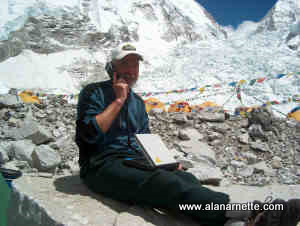
A: There are internet cafes in Lukla, Namache and a few villages up to Gorak Shep (last before EBC). They charge a reasonable price for being where it is but not 100% reliable. Satellite phones are the most common method. I use Thuraya which transmits both voice and data (including email) from anywhere within their coverage area. Some tea house offer satellite or wired phone service but these cannot be depended on. Expedition companies charge anywhere from $3 to $7 USD per minute so charges can rack up quickly.
A Thuraya phone cost about $800 US and $1 a minute or less. If you will use more than 800 minutes and go on multiple treks, buying a phone makes a lot of sense. The Thuraya satellites only covers Europe and Asia and not the US or South America. Iridium is the other option but it does not perform as reliably in my experience. See the technology section on my gear page for details. For details on my expedition communications, please see this tutorial.
Q: Do SPOT satellite beacons work?
A: Yes. Just point the device mostly east. It is an easy and inexpensive way to letting those back home know where you are and you are ok. Remember it only tracks 7 days of data however on the Google Map. For details on my expedition communications, please see this tutorial.
Q: Do cell phones work outside of Kathmandu?
A: Yes. GSM (not CDMA e.g. Version) cell phone service is available with a Nepal Cell phone company SIM card. Check with your outfitter. It can be arranged in KTM. However, for guaranteed access rent a Thuraya sat phone here in the US or in KTM. For details on my expedition communications, please see this tutorial.
Q: How do you recharge batteries?
A: The teahouses have charging ability via their solar panels but if it has been cloudy for several days, there may not be enough reserves to charge a computer or camera thus always have an extra battery. Teahouses usually charge for it - maybe a 100 rupees an hour so bring some extra cash. Many people want to use their chargers so try to plug your stuff in as soon as you arrive. A solio power charger is a good idea for battery recharger. For details on my expedition communications, please see this tutorial.
The Trek
Q: What about money?
A: It seems like everything costs 100 to 200 rupees - candy bar, bottle water, extra fried rice at dinner. You will pay for hot showers or to use the battery for charging. You will spend more than you think so bring lots of rupees in smaller dominations. 100s are great, stay away from 500 and 1000 notes. US dollars are sometimes taken but rupees are preferred.
Q: How many miles do you walk each day?
A: It is about 38 miles from Lukla to EBC and it should take a minimum of nine days. You generally walk about 4 to 6 hours each day starting about 8:00AM.
Q: What are the conditions in the tea houses along the route?
A: Actually pretty good if you are not with a low cost guide service - they pick the old teahouses. The better services book trekkers in solid teahouses that are quite clean. but I still recommend using your own sleeping bag and not their sheets/pillows
Q: Is it always advisable to treat the water?
A: Not in the teahouse since they double boil most of the time. On the trail, iodine is best but a SteriPen would work best - bring extra batteries, etc. All that said, expect to get some intestinal issue at some point - everyone does.
Q: Any info on the prevalence of Guardia?
You never want to drink untreated water or muddy water from streams or still water even if you see the locals doing it. Always drink treated water. You can buy bottled water from the teahouses but it creates a huge waste problem. It is best to treat water from the teahouse tap with iodine or a SteriPen to eliminate the waste of the bottle.
Q: Can I get lost?
A: Yes. The vast majority of the time you are on a well worn trail with other people ahead or behind you. But this is a sparse country and the villages are miles apart. it is easy to follow a yak trail instead of the main trail. There are multiple valleys along the way and going up the wrong valley can be a huge mistake. Carry a map and don't get away from your group.
Q: What if I want to climb a mountain?
A: There is Kala Patar at 18,192' just above Gorak Shep. It is a wonderful easy climb that offers amazing views of Everest, base camp and all the surrounding mountains. It is a must do activity. Just make sure you have been acclimatizing properly and take it slow and easy. Schedule a day if possible. Go early in the morning to avoid the afternoon clouds that block Everest.
If you want to climb something more technical, then the trekking peaks of Island Peak (20,305'), Lobuche and Mera are also available but these generally require a fair amount of climbing experience with crampon and ropes. They also require climbing permits and are not consider part of a normal trek only itinerary.
Q: Can I spend the night at Everest Base Camp or go into the Icefall?
A: For 2013, check for the latest regulations. In 2012 the rules changed banning all trekkers, including those with climbing teams, from staying at Base Camp. However, it was rescinded at the last minute. In the past, if you are with a climbing expedition, you can spend the night at EBC. To enter the Icefall legally requires a mountaineering permit.
Q: How do climbers feel about Trekkers?
A: It is a small community up there. However, climbers will sometimes shy away from interacting with strangers after they have been in BC for a few weeks. They have probably already gone through all the contagious stuff and do not want to be exposed to new strains. It is not personal but they have paid tens of thousands to climb Everest and don't want to get sick.
Q: What is the standard schedule to EBC?
A:This varies but to go from Kathmandu to EBC and back this is a representative schedule:
- Arrive Kathmandu at 4600'
- Rest and tour Kathmandu
- Tour Kathmandu
- Fly to Lukla at 9250', weather permitting
- Trek to Phakding (or Monjo)at 8694' (mostly flat to downhill)
- Trek to Namache at 11,300' (significant uphill trek) visit the market, Everest museum, local schools, bakery, Everest View Hotel
- Rest day and tour in Namache
- Trek to Thame at 12,464' visit the Thame Monastery. Not part of every trek
- Trek to Tengboche (or Deboche) at 12,683' visit the Monastery, meet the Rinpoche
- Trek to Periche at 13,907' visit the Himalaya Rescue Association
- Trek to Lobuje at 16,174 see the Sherpa Memorial en route
- Trek to Gorak Shep at 16,924
- Climb Kala patar 18,192' with outstanding views of Everest Base Camp, Ama Dablam and Mount Everest
- Trek to Everest Base Camp at 17,500' and return to Gorak Shep
- Trek back to Dingboche at 14,450
- Trek to Namache
- Trek to Lukla, a long day
- Fly to Kathmandu, weather permitting
- Rest, sight see and finalize travel home
- Fly home
Q: Any suggested highlights?
A: Try to be in Namache on a Saturday morning for the weekly market. Go to morning prayers at the Monastery in Tengboche. Spin every prayer wheel you pass. Climb Kala Patar. Stop and talk to the children, take their pictures and show it back to them. Ask adults if you can take their picture. If you have time visit Goyko and Chhukhung. Take 10 times more pictures than you think you should. Walk slow and enjoy each moment! You can read about my trek for my experience.
Q: Is the a good book I should read before?
A: Yes. Everest Base Camp - a trek with Ang Dorge Sherpa is a recent well written description of the trek fro Randy Birch who made the trek in 2012. You can buy it on Amazon
Q: Should I give anything the kids along the trek holding out their hands?
A: Yes, writing pens e.g. BICs and tooth brushes and tooth paste.
Everest Facts
Q: Exactly where is Mt. Everest?
A: On the border between Nepal and Tibet (China). It is in the Himalaya mountain range which stretches 1500 miles from Northeastern Pakistan to Bhutan. There are over thirty mountains higher than 25,000 feet. Of the fourteen 8,000 meter peaks, nine are located in the Himalayas making it clearly the top of the world.
Q: How do they know the altitude?
A: In 1841 a British surveyor named Sir George Everest identified the location of the mountain. Fifteen years later using trigonometry and measurements from 12 different survey stations around the mountain 'Peak XV' was surveyed as the world's highest mountain at 29,002 feet. In 1865 it was re-named Mt. Everest and is called Sagarmatha by the Nepalese and Chomolungma (Jomolangma) in Tibet. In 1955, the height was adjusted to 29,028'. On May 5,1999 a National Geographic Society Expedition put a GPS receiver on the summit. Using a second Trimble GPS receiver at the 26,000' South Col they could make an extremely accurate measurement by running the two receivers simultaneously. The new altitude was 29,035 feet or 8,850 meters. However, the Nepalese still use 29,028' as the official altitude. In December, 2020 Nepal and China jointly announced a new measurement of Everest. Taking several years and using historic (theodolite) and modern (satellite, GPS and radar) methods a new height was changed to 29,031.69-feet or 8848.86-meters. This was adopted by both counties but not by all organizations worldwide who still use 29,031'/8848m.
Q: What were the standout climbs?
A: In 1924, George Mallory and Sandy Irvine made the first serious attempt. It is still unknown if they made the summit, but both died on the mountain. In 1953, Tenzing Norgay and Sir Edmund Hillary make the first successful summit. In 1975, Japanese Junko Tabei became the first woman to summit the hill. Austrian Peter Habeler and Italian Reinhold Messner were the first trekkers to summit Everest without bottled oxygen. 1996 was probably the most controversial year with fifteen trekkers dying on the mountain thus spawning worldwide debate and interest in alpine mountaineering.
Q: How many people have summited and how many people have died trying?
A: The Himalayan Database reports that through January 2024, there have been 11,996 summits (5,899 members and 6,097 hired) on Everest by all routes by 6,664 different people. Those climbers who have summited multiple times include 1,571 members and 1,048 Sherpa, for 5,333 total summits. There have been 883 summits by women members.
Statistics Updated through December 2024
The Himalayan Database reports that through December 2024, there have been 12,884 summits of Everest through December 2024, on all routes by 7,269 different people. Those climbers who have summited multiple times include 1,670 members and 2,003 Sherpa, for 4,620 total summits. There have been 962 summits by women members.
Summits
The Nepal side is more popular, with 9,156 summits compared to 3,728 summits from the Tibet side. Only 229 climbers summited without supplemental oxygen through December 2024, about 1.7%. Only 35 climbers have traversed from one side to the other. Member summit success stands at 39%, with 5,899 who attempted to summit, making it out of 14,496 who tried. About 66% of all expeditions put at least one member on the summit. Few climbers have summited from both Nepal and Tibet, totaling only 681. Even fewer, 155, have summited more than once in a single season.
Almost all Sherpas, 78, have summited within seven days of their first summit that season. Kami Rita Sherpa (Thami) holds the record for most summits at 31, with Paswang Dawa (PA Dawa) Sherpa of Pangboche close behind with 27 summits. Brit Kenton Cool has 18 for a non-Sherpa record. Eleven Sherpas have 20 or more summits. One hundred and one Sherpas have summited Everest 10 or more times. Member climbers from the USA have the most country member summits at 1,078, followed by China at 683, India at 605, and the UK at 560.
Deaths
As for Everest deaths, 335 people (203 Westerners and 129 Sherpas) died from 1922 to December 2024. These deaths account for about 2.7% of those who summited, resulting in a death rate of 1.11% among those who attempted to reach the summit. Westerners die at a higher rate of 1.36%, compared to Sherpas at 0.84%. Descending from the summit is deadly, with 74 deaths, or 22% of the total fatalities. Female climbers have a lower death rate of 0.81% compared to 1.14% for male climbers, and 14 women have died on Everest.
The Nepalese side has seen 9,156 summits with 225 deaths through December 2024, or 2.5%, representing a rate of 1.12%. One hundred thirty deaths, or 27%, did not use oxygen. The Tibet side has witnessed 3,728 summits with 98 deaths through December 2024, or 2.6%, a rate of 0.98%. Thirty-eight individuals died without using oxygen. Countries with the most deaths among climbers include India at 28, the UK (19), Japan (19), the US (17), and China (12), with South Korea at 11. Nepal has the absolute highest number of deaths at 135, dominated by Sherpas. Most bodies remain on the mountain, but China has removed many from view on its side. The top causes of death are avalanches (77), falls (75), altitude sickness (45), and exposure (26).
Latest: Spring 2024
In 2024, 861 summits were made, including 74 from Tibet and 787 from Nepal. All but 5 used supplemental oxygen. 77% of all attempts by members were successful. Of the total, 73 females summited. The Tibet side saw a 67% summit rate compared to 68% on the Nepal side. Eight Everest climbers died.
Everest compared to Other 8000ers
Everest is becoming safer even though more people are now climbing. From 1923 to 1999, 170 people died on Everest with 1,170 summits, or 14.5%. But the deaths drastically declined from 2000 to 2024, with 11,714 summits and 165 deaths, or 1.4%. However, four years skewed the death rates, with 17 in 2014, 14 in 2015, 11 in 2019, and a record 18 in 2023. The reduction in deaths is primarily due to significantly higher Sherpa support ratios, improved supplemental oxygen at higher flow rates (up to 8 lpm), better gear, accurate weather forecasting, and more people climbing with commercial operations.
Of the 8,000-meter peaks, Everest has the highest absolute number of deaths (member and hired) at 335 but ranks near the bottom with a death rate of 1.11. Annapurna is the most deadly 8,000er, with one death for about every fifteen summits (73:514) or a 3.30 death rate. Cho Oyu is the safest, with 4,158 summits and 52 deaths, or a death rate of 0.54, with Lhotse next at 0.61. Of note, 81 Everest member climbers out of 206 member deaths died descending from the summit, or 39%. K2's death rate has fallen dramatically from the historic 1:4 to around 1:8, primarily due to more commercial expeditions with large Sherpa support ratios.
see more facts here |